Comprehensive DMPK Service Portfolio

In vivo ADME, in vitro ADME, bioanalysis, tox preliminary and efficacy evaluation — every study anchored on one accountable, mass-spec-driven platform.

In Vivo PK / TK

Rodent & NHP PK, BE, DDI, tissue distribution

In Vitro ADME

Stability, CYP450, transporters, physicochemical

Bioanalysis

LC-MS/MS, large-molecule MS, LBA specialties

Tox Preliminary

Acute tox, dose-range, tolerability & MTD

Efficacy Models

Hyperuricemia, hyperlipidemia, hypertension

In vivo PK/TK studies in NHP
300+ NHP PKdedicated monkey facility
In Vivo PK / TK

Pharmacokinetics built around the NHP and rodents

Single- and repeat-dose PK with full parameterization across cynomolgus monkeys, rats, mice, dogs and minipigs — supported by a dedicated animal facility and advanced surgical & sampling capabilities.

  • Single & repeat-dose PK / TK · crossover BE & formulation screening
  • Dose linearity & dose escalation · in vivo DDI · PK / PD biomarker linkage
  • Tissue distribution · excretion / mass balance · in vivo metabolite ID
  • Toxicokinetics (TK) & dose-range exploration · target tissue exposure
  • Species: mouse · rat · dog · monkey · minipig  |  Routes: IV · PO · SC · IM · IP · inhalation
  • Surgery & sampling: jugular / bile-duct cannulation · serial blood · CSF / bile / pleural fluid
Quote an in vivo PK study
What is in vivo PK and why does it matter?

Pharmacokinetics describes what the body does to your drug — absorption, distribution, metabolism and excretion (ADME) over time. A well-designed in vivo PK study tells you the half-life, clearance, volume of distribution and oral bioavailability of your candidate, which are the inputs for dose prediction, dose-interval selection and IND-enabling toxicology dose design. Multi-species data (e.g. mouse, rat, beagle, NHP) are the standard basis for human PK projection.

In Vitro ADME

Answers before you dose

Controlled clean-room operations with qualified instruments and validated workflows — a complete in vitro ADME suite across species and matrices.

  • Metabolic stability — microsomes · S9 · hepatocytes · plasma / blood across human, rat, mouse, dog, monkey, minipig & more
  • CYP450 enzymology — inhibition (CYP1A2/2B6/2C8/2C9/2C19/2D6/2E1/3A4), time-dependent inhibition (IC50 shift · Ki/Kinact), induction, reaction phenotyping (CYP / UGT)
  • Transporters & permeability — P-gp, MRP2, BCRP substrate & inhibition; Caco-2 permeability
  • Physicochemical & metabolites — solubility · LogD / LogP · pKa · metabolite prediction / ID / pathway
  • Plasma protein & tissue-cell binding · blood / plasma partition · cross-species metabolite ID
Quote an ADME assay
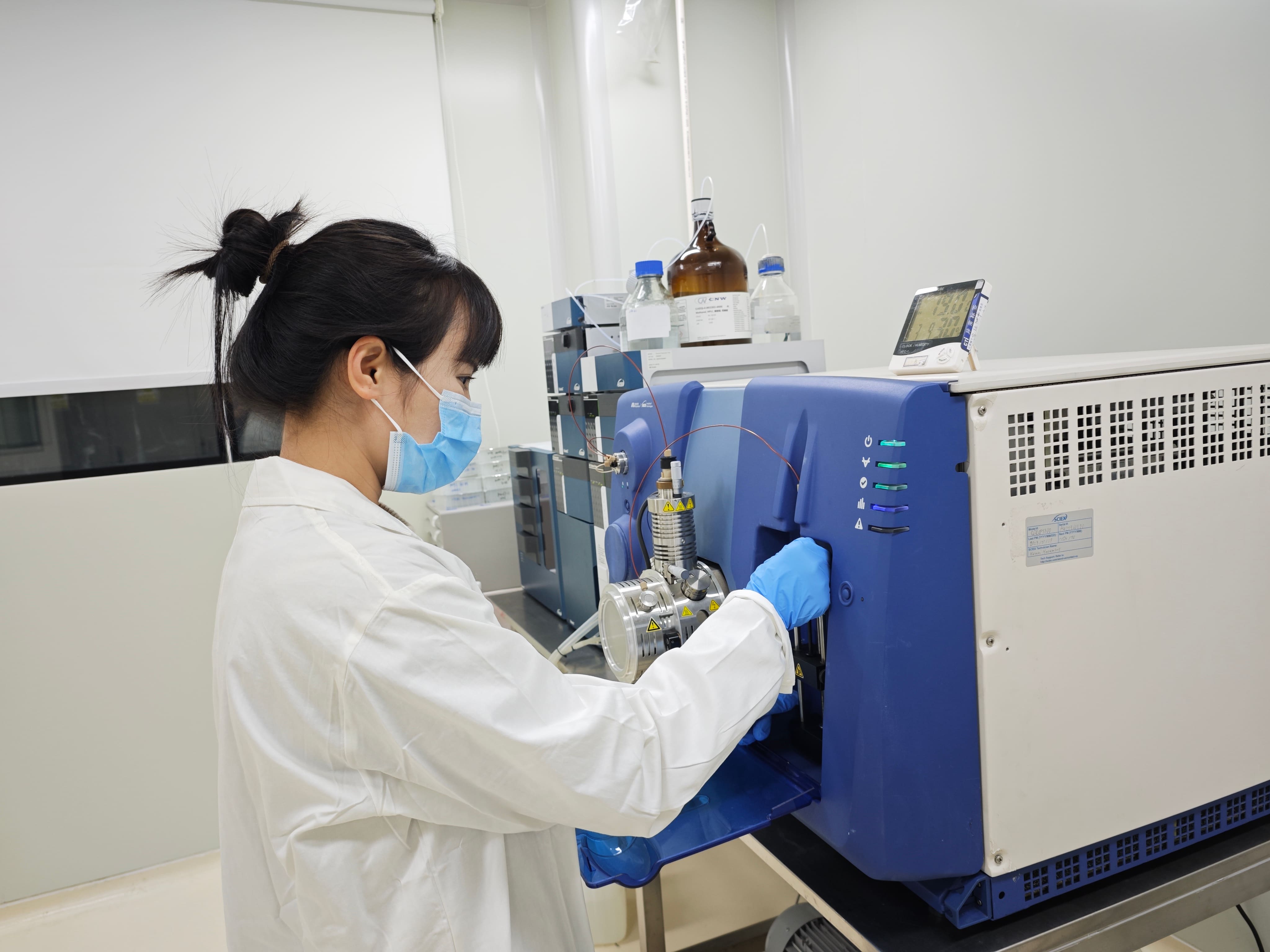
In vitro ADME assays in the lab
8 CYP isoformsinhibition panel
In vitro ADME — the assays that de-risk a lead before you dose

Metabolic stability (microsomal / hepatocyte) tells you how fast the liver clears your compound; CYP450 inhibition flags clinical drug-drug interaction risk; plasma protein binding defines the free fraction that reaches the target; Caco-2 and transporter assays predict absorption and efflux. Run together across 5 species, these data rank compounds for lead optimization and set realistic expectations for in vivo exposure — all in under 5 business days.

LC-MS/MS bioanalytical platform
SCIEX QTRAP 5500LC-MS/MS · 6500+ · Q-TOF
Bioanalysis

Characteristic bioanalysis for hard-to-measure analytes

Method development that turns "hard to measure" into routine, reliable bioanalysis — quantitative LC-MS/MS, large-molecule mass spec and ligand-binding assays.

  • Small molecule / peptide / metabolite LC-MS/MS · plasma, serum, tissue, CSF across species
  • Large-molecule MS — intact / reduced MW · subunit · ADC DAR · mAb quantification
  • Low-sensitivity compounds — endogenous hormones (testosterone, progesterone, vitamin D), sub-pg/mL sensitivity for challenging analytes
  • Unbound (free) drug fraction — albumin-conjugated & liposomal drugs
  • Derivatization & labile compounds — methimazole, mycophenolic acid, statins under tightly controlled conditions
  • Tiered service: T1 screening · T2 PK · T3 IND · T4 GLP — fit-for-purpose, GxP-aligned
Quote bioanalysis
LC-MS/MS bioanalysis — sensitivity, matrix effects and method fit-for-purpose

Bioanalytical LC-MS/MS quantifies drug and metabolite concentrations in plasma, serum, tissue and CSF. The challenges are real: low-dose potent drugs need pg/mL LLOQ, labile compounds (lactones, esters, prodrugs) degrade in matrix, and matrix effects can suppress ionization. Our SCIEX QTRAP 5500 / 6500+ / Q-TOF platform, sub-pg/mL sensitivity for challenging analytes, makes these hard analytes routine — with tiered service (T1–T4) aligned to GxP expectations.

Tox Preliminary

Early safety assessment

Acute toxicity, dose-range finding and maximum tolerated dose (MTD) exploration — data to support formal tox and IND dose design, with full welfare & ethics compliance.

  • Acute toxicity (single dose, dose escalation)
  • Repeat-dose & dose-range studies · tolerability and MTD exploration
  • Clinical observation · body weight · biochemistry · necropsy
  • IACUC-approved protocols, AAALAC-style care
Quote a tox / MTD study
Tox preliminary studies
MTD + INDdose design support
What are MTD and tox preliminary studies?

Maximum tolerated dose (MTD) exploration finds the highest dose your candidate can be given without unacceptable toxicity. Tox preliminary (dose-range finding) studies assess acute toxicity, tolerability and clinical pathology before formal GLP tox — guiding dose selection for IND-enabling studies. Because scope varies with dosing schedule, endpoints and sampling, we quote these as an indicative range and confirm a firm price with a full protocol.

Efficacy disease models
3+ modelsmetabolic & cardiovascular
Efficacy Evaluation

Disease models with reliable readouts

In vivo efficacy evaluation in established disease models with routine efficacy screening support.

  • Hyperuricemia model — urate-lowering efficacy assessment
  • Hyperlipidemia model — lipid-lowering efficacy assessment
  • Hypertension model — blood-pressure-lowering efficacy assessment
  • Routine efficacy screening & custom model design support
Quote an efficacy study
Choosing the right efficacy model

Efficacy models connect your candidate to a measurable disease readout. Our established models — hyperuricemia (urate lowering), hyperlipidemia (lipid lowering) and hypertension (blood-pressure lowering) — provide reliable endpoints for proof-of-concept and candidate ranking. Custom model design is available; because model, group design and readouts vary, we quote efficacy as an indicative range and confirm firm pricing with your protocol.

Not sure which study fits your program?

Talk to a DMPK scientist directly — we design fit-for-purpose studies and quote transparently.